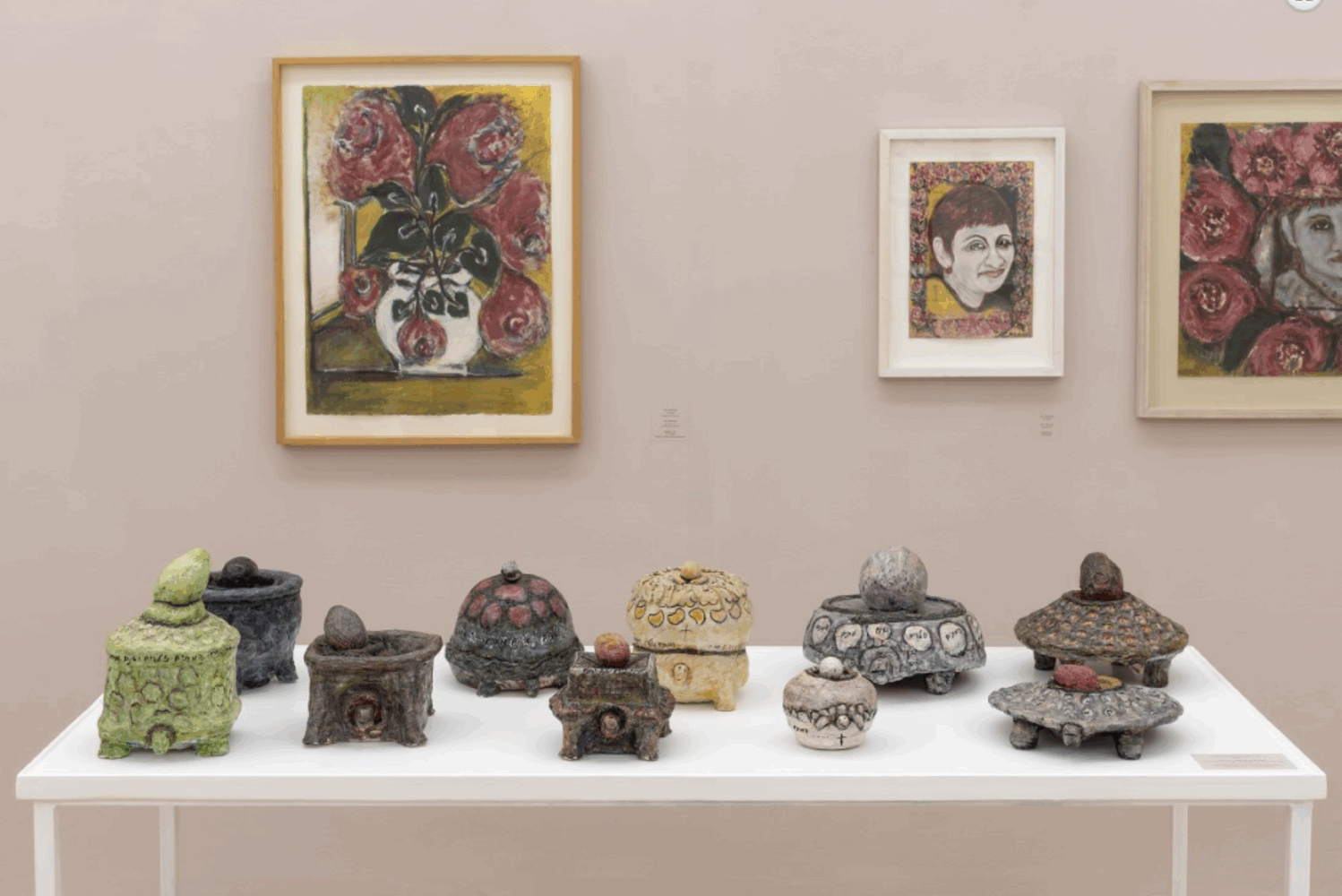
Bianca Eshel-Gershuni
It is difficult, and likely unnecessary, to tell a single, consistent and cohesive story about Bianca Eshel-Gershuni’s (1932-2020) 60 years of creation. Over the years, Eshel-Gershuni had been active in various disciplines and media, such as goldsmithing, sculpture, painting, assemblage, and writing. She had also employed multiple techniques, from flattening and soldering to digital painting. Combining narrative, materiality, emotion, and conceptuality, her work often features diverse themes, including marriage and birth, worship and ritual, crucifixion, and nationalism.
Eshel-Gershuni was a groundbreaking and distinct multidisciplinary artist in the Israeli art field. Her style and the autobiographical themes she addressed were aberrant among the local art scene. The art she created was rooted in the childhood trips she took with her father to the churches of Bulgaria, and she often confronted the personal tragedies she experienced—the death of her first husband, Moshe Eshel, while serving as a fighter pilot during the Sinai War, and her separation from her second husband, artist Moshe Gershuni, who came out of the closet. Alongside the biographical content, there were Christian themes and ritualistic language, rich materiality, and a deep acquaintance with the history of art. She moved back and forth between highbrow and lowbrow culture, between the miniature and the monumental, the decorative and the artistic. Despite being a highly regarded artist, showing her works in art venues such as the Israel Museum and the Tel Aviv Museum, and even receiving a Lifetime Achievement Award from the Ministry of Culture in 2009, she worked largely on the margins. She was not an integral part of mainstream art, nor of the canonical trends of Israeli art. This exhibition is her first retrospective.